
Same failures, different decade: white paper calls for new tactics to prevent grantmaking mistakes
Posted on 03 Aug 2026
A decade of Australian auditor-general reports shows grantmakers and decision makers repeatedly…
Posted on 01 May 2025
By Matthew Schulz journalist, SmartyGrants

A rating system developed by UK foundations offers valuable insights into how grantmakers around the world can improve governance, accountability and equity.
The Foundation Practice Rating project has assessed more than 100 UK charitable foundations across more than 100 criteria in a push to increase transparency, fairness, and trust in the foundation system, which distributes more than £6.4 billion a year, about $12.1 million in Australian dollars.
For its 2024–25 annual report, the project – which was initiated by the Friend Provident Foundation and is carried out by independent evaluators – assessed foundations in terms of diversity, accountability and transparency, scoring each with a rating from A to D.
The report found foundations were weakest in measures of diversity, with 44% of organisations scoring the lowest “D” rating and none at all winning an “A” rating.
Foundations were strongest in transparency, where 64% scored an “A” rating.
Foundations scored a relatively equal spread of Bs (33%), Cs (28%) and Ds (29%) for their accountability.
“Quite often we are keen to evaluate the effectiveness of grantee programmes and are concerned about the rigour of those assessments. The FPR suggests that we are less rigorous with evaluating our own work and seeking feedback.”
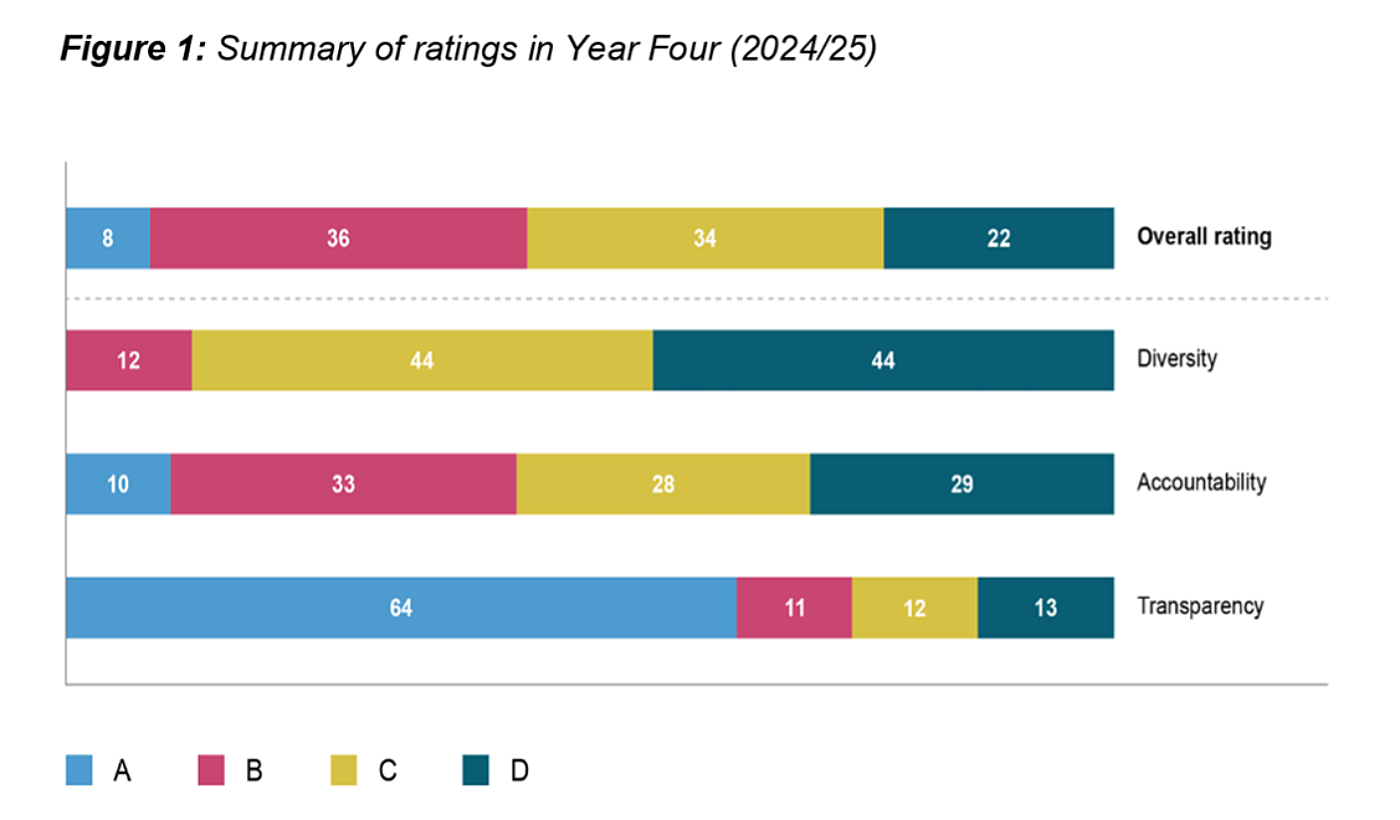
Despite the fact that transparency was the strongest suit of foundations, 21 foundations did not have a website, while many others had sites that were “limited” or hard to navigate.
Just seven out of 100 foundations published a detailed analysis of how effective they had been.

Friends Provident Foundation director Danielle Walker Palmour told Grants Management Intelligence that diversity had “proven the trickiest” quality for foundations to improve, and in fact it had worsened since the last study a year earlier.
“We were a bit surprised that performance on diversity was not improved, given the first foundation to score an A in diversity (and overall) occurred last year. Our hope is by providing clear examples of good practice, performance in key domains will improve.”
Foundations in the UK appear largely pale, male and stale. The most recent assessment in England and Wales found that 90% of trustees of foundations were white, 60% were over 65 years of age, and men outnumbered women two to one.
Palmour said the report’s diversity assessment looked not only at trustees, but at foundations more broadly.
“By diversity the FPR includes disclosures about the makeup – in terms of ethnicity, gender and disability – of those that make decisions and deal with applicants: staff and trustees.
“It also includes accessibility of websites – quite often our shop windows as funders – to those who may have difficulty using screens.”
She stressed that the rating system was produced to assist potential grant applicants.
“This is not a question of virtue-signalling or political correctness. The point of this domain in the rating system is about giving applicants key information about the makeup of those taking decisions that may affect their lives and livelihoods, and the ability of a range of people to access what is sometimes the only information available”.
Palmour also said that foundations could improve the assessment of their funding effectiveness.
“Quite often we are keen to evaluate the effectiveness of grantee programmes and are concerned about the rigour of those assessments. The FPR suggests that we are less rigorous with evaluating our own work and seeking feedback.”
Palmour said transparency was the most important metric.
“Transparency is the medium through which all the other domains are mediated – if there is no transparency of practices, then we really cannot know anything else about the foundation. Caroline Fiennes, who leads our research efforts, is a physicist by training. She likens our efforts – and those of applicants – to those of astronomers: we can only understand what is going on inside stars (or foundations) from the light that comes out.”
According to the report, the best performing foundations “by an appreciable margin” were community-run foundations.
Community foundations in Australia are now the fastest growing philanthropic sector and are predicted to build a billion-dollar funding pool in the next few years.
Palmour said the best-performing groups were “characterised by curiosity about how to improve, clarity on to whom they seek to be accountable, and a willingness to share their journey”.
“A great example of this remains community foundations; they consistently perform best in all four cohorts since 2021.
“They are very clear that they are accountable to their locality, seek to reach out in a range of ways to their populations and share what and how they have done with donors and other stakeholders. Those we have sampled provide exemplars to us all.”
Palmour said the rating process aimed to raise the standards for funders.
“We see our role as a lightning rod – a way of focusing attention on performance and good practice in the grantmaking sector.
“Whilst we have their attention, we do two things: we highlight good approaches, as every criteria has a foundation that has achieved it; and we signpost to key areas of support like our umbrella bodies, the Association of Charitable Foundations, Community Foundations UK, and 360 Giving. They create relevant and useful materials and offer networks for on-going support.”
Drawing comparisons between UK and Australian philanthropy, Palmour said she believed UK foundations were well placed in terms of their openness.
“Transparency is one of UK foundations’ areas of strength. Part of this is the wider charity framework in which we operate through our regulators such as the Charity Commission in England and Wales, the Office of the Scottish Charity Regulator and the Northern Ireland Charity Commission. This ensures that charities have a consistent set of information disclosed about their activities, finance and governance.”
At this stage, Australia has no comparable philanthropic rating system, but Palmour welcomed the curiosity and interest shown by Australian philanthropists, who were “looking to the US and Europe for examples of new approaches”.
Posted on 03 Aug 2026
A decade of Australian auditor-general reports shows grantmakers and decision makers repeatedly…

Posted on 25 Jun 2026
Australia distributes an estimated $125 billion in grants annually, but grantmaking, unlike…
Posted on 25 Jun 2026
The federal government's Community Sector Grants Engagement Framework is "on track," the Department…

Posted on 25 Jun 2026
Australia’s grants administration system has centralised bureaucracy instead of expertise, creating…

Posted on 25 Jun 2026
Nine in 10 Australian social impact measurement practitioners are now using AI in their work, but…

Posted on 24 Jun 2026
More than 300 of Australia’s top social impact professionals and leaders will gather in Sydney on…

Posted on 03 Jun 2026
A new report has found that ongoing financial, workforce and governance pressures mean the…

Posted on 20 May 2026
The Australian National Audit Office (ANAO) has released a new report in its Audit Lessons series,…

Posted on 20 May 2026
The NSW government's administration of a flood recovery grants program has largely met requirements…
Posted on 07 May 2026
A Tasmanian parliamentary inquiry has heard new evidence that the state's Department of Health has…

Posted on 07 May 2026
A fast-growing region of New Zealand – home to the world’s best adventure tourism, awe-inspiring…
Posted on 07 May 2026
Organisers of Blak Loungeroom, a historic Indigenous-led philanthropy conference held in Melbourne…