Community grants framework delayed as funding concerns remain
Posted on 25 Jun 2026
The federal government's Community Sector Grants Engagement Framework is "on track," the Department…
Posted on 14 Dec 2021
By Matthew Schulz, journalist, Our Community
An analysis of more than 500,000 SmartyGrants grant applications, representing at least $6 billion of funding by more than 440 grantmakers over eight years, reveals funders making radical shifts in spending as covid-19 hit.
The report, The Future of Funding: What are the priorities and directions of Australian grantmakers?, analyses funds distributed on the SmartyGrants platform between 2013 and 2020.
The study used the platform’s powerful classification system CLASSIE to separate grants into social sector subject areas to show how the money flowed.
This graph shows the proportion of all applications by subject area over the 2019-2020 years, and tracks a shift in grant demand.
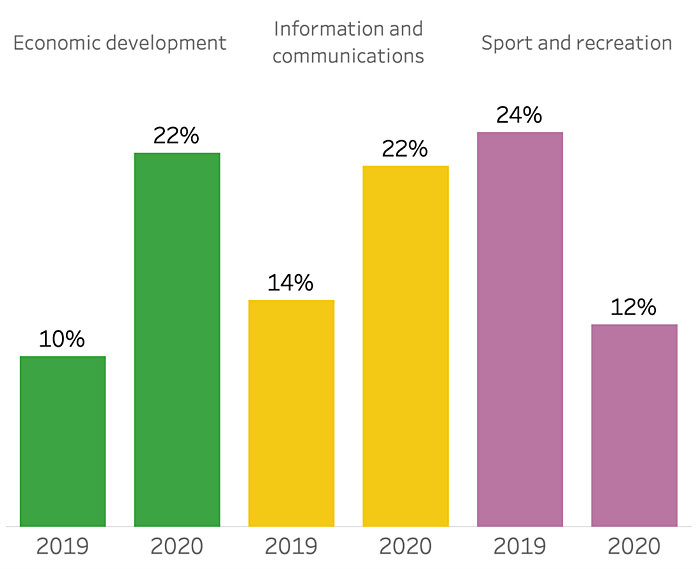
Overall, the study found that at the height of covid-19 responses in 2020:
According to the Our Community study by Innovation Lab data scientist Dr Nathan Mifsud, approvals for information and communications grants dropped to just 25% as applications trebled in one year to more than 34,000 in 2020.
He said the spike reflected “a need for organisations to respond to changing service delivery and, for some workers, remote work requirements”.
The state, territory and federal grants approval spike was concentrated in grants worth less than $50,000 and especially in small grants in the $1,000 to $5,000 range. Whereas grant approvals hovered around 53% in 2019, that leapt to 75% as governments raced to get funds out the door.
The reverse was true in local government, where approvals dropped from 70% in 2019 to 54% in 2020, with a dramatic drop in approvals in the $1,000 to $5,000 range. That drop was offset by a moderate rise in approvals for grants worth more than $50,000.
Dr Mifsud said the changed approval rates may reflect a change in local government priorities as a result of covid-19, or a change in the number and kind of applications being submitted, or both. For instance, there may have been a reduction in applications in subject areas associated with smaller grants, and an increase from organisations in subject areas that typically apply for large grants.
The study also saw significant changes in priority spending for economic development, arts and culture, and education. That trend aligned with the support given to businesses, artists, performers and students in the first nine months of the covid-19 crisis.
Despite the increase in funding, demand for grants in key areas continued to outstrip supply. For example, education applications more than doubled to 20,070; health applications rose more than 50% to 15,153; and arts and culture applications spiked at 30,424, up more than 12,000 on the previous year.
Sport and recreation funding dropped down the priority list for funders during the period, losing out as a proportion of total funds allocated, while approval rates dipped from 37% to 29% of applications in 2020.
The study also shows philanthropic foundations and trusts slashed overall grants expenditure during the crisis, diverting funds from large grants to smaller ones.
Approvals for grants worth more than $1 million slumped from 65% to 34% in 2020, while approvals rose for grants worth less than $50,000.
The report is expected to be released in early 2022 and will show a detailed breakdown of priority areas for funders, including top subject and beneficiary groups.
Earlier this year, the SmartyGrants Covid-19 Grantmaking Survey, revealed that in response to the pandemic:
That study also revealed a greater emphasis on community and economic development and a reduction in help for sport and recreation; arts and culture; and environmental causes.
The Future of Funding: What are the priorities and directions of Australian grantmakers?
Grantmakers shift focus, funding and processes, SmartyGrants covid-19 grantmaking survey shows
Federal figures reveal how $60 billion dollars’ worth of grants funding flows
How SmartyGrants responded to the covid-19 emergency
More SmartyStats: How applicants are lodging forms | Funders faster to respond to applications
Posted on 25 Jun 2026
The federal government's Community Sector Grants Engagement Framework is "on track," the Department…

Posted on 15 Dec 2025
The federal government’s recent reforms to the Commonwealth procurement rules (CPRs) mark a pivotal…
Posted on 05 Mar 2024
A Melbourne council has broken new ground by revealing details of an early evaluation of its grants…

Posted on 10 Dec 2018
The founder and director of Grant Professionals, Robert Palmaricciotti, provides specialist grant…

Posted on 08 Oct 2019
The Ian Potter Foundation is building a strong reputation for its laser-like focus on evaluation…

Posted on 18 Jun 2019
Grantmakers are in prime position to steer their masters towards best practice when it comes to…

Posted on 15 Oct 2020
With billions of dollars in government money allocated to Australia’s pandemic response and…

Posted on 04 Sep 2018
In a world of grantmaking often spun around lengthy applications, mid-term evaluations, detailed…

Posted on 24 Sep 2024
A new aged care foundation has been established to address what its founders claim is a significant…